
Featured guide · Dough, crust and baking traditions
Pizza Styles
Pizza styles are shaped by much more than whether the crust is “thin” or “thick.” Hydration, dough weight, fermentation, shaping, oil, baking surface and oven temperature all influence the structure of the finished pizza.
A Neapolitan pizza can be thin through the centre but dramatically inflated around the rim. A New York slice is also thin, yet usually firmer, chewier and crisp enough to fold. Detroit, Sicilian and other pan pizzas may all be described as thick, even though their dough structure and baking methods are quite different.
This guide approaches pizza styles through the dough and crust itself: how the dough is formulated, fermented, shaped and baked, and how those decisions create the characteristic texture of each style.

What defines a pizza style?
A pizza style is the result of a system, not a single ingredient
Two pizza doughs can use the same flour and even the same hydration yet produce very different crusts if their dough-ball weight, fermentation, shaping method or baking conditions change.
Likewise, a high-hydration dough does not automatically make a pizza “Neapolitan,” and a thick pizza is not automatically “Sicilian.” The characteristic result comes from several variables working together.
Six defining variables
The same basic ingredients can produce remarkably different pizza
Flour, water, salt and yeast form the foundation of most pizza dough, but the proportions and process around those ingredients determine whether the finished crust becomes soft, chewy, cracker-like, focaccia-like, airy or crisp.
How much water is used relative to the flour?
Firmer doughs are often easier to roll thin and bake crisp, while wetter doughs can support a more open, airy internal structure when the flour, fermentation and handling suit them.
How much dough is used for a given pizza size?
Dough-ball weight and pan area strongly influence physical crust thickness. A higher hydration does not necessarily mean a thicker pizza if very little dough is used.
How long and under what conditions does the dough ferment?
Fermentation affects gas development, extensibility, flavour and handling. A short warm rise and a long refrigerated fermentation can create very different dough behaviour.
Is the dough stretched, rolled, pressed or proofed in a pan?
Hand stretching can preserve an inflated rim, rolling can suppress large bubbles for a thin crisp crust, and pan proofing encourages a different structure again.
Is fat included in the dough or around it during baking?
Oil can tenderise dough and influence browning. In pan styles, a generous layer of oil can also create a noticeably crisp or fried-style underside.
How hot is the oven and what is the pizza baked on?
A very hot stone or oven floor produces a fundamentally different bake from a lower-temperature domestic oven or a heavy oiled pan. Bake time changes with it.
Four useful pizza families
Most dough-driven pizza styles become easier to understand when grouped by their finished crust
These are intentionally broad families rather than rigid historical classifications. They provide a practical map before looking at individual styles in more detail.
Family 01
Neapolitan family
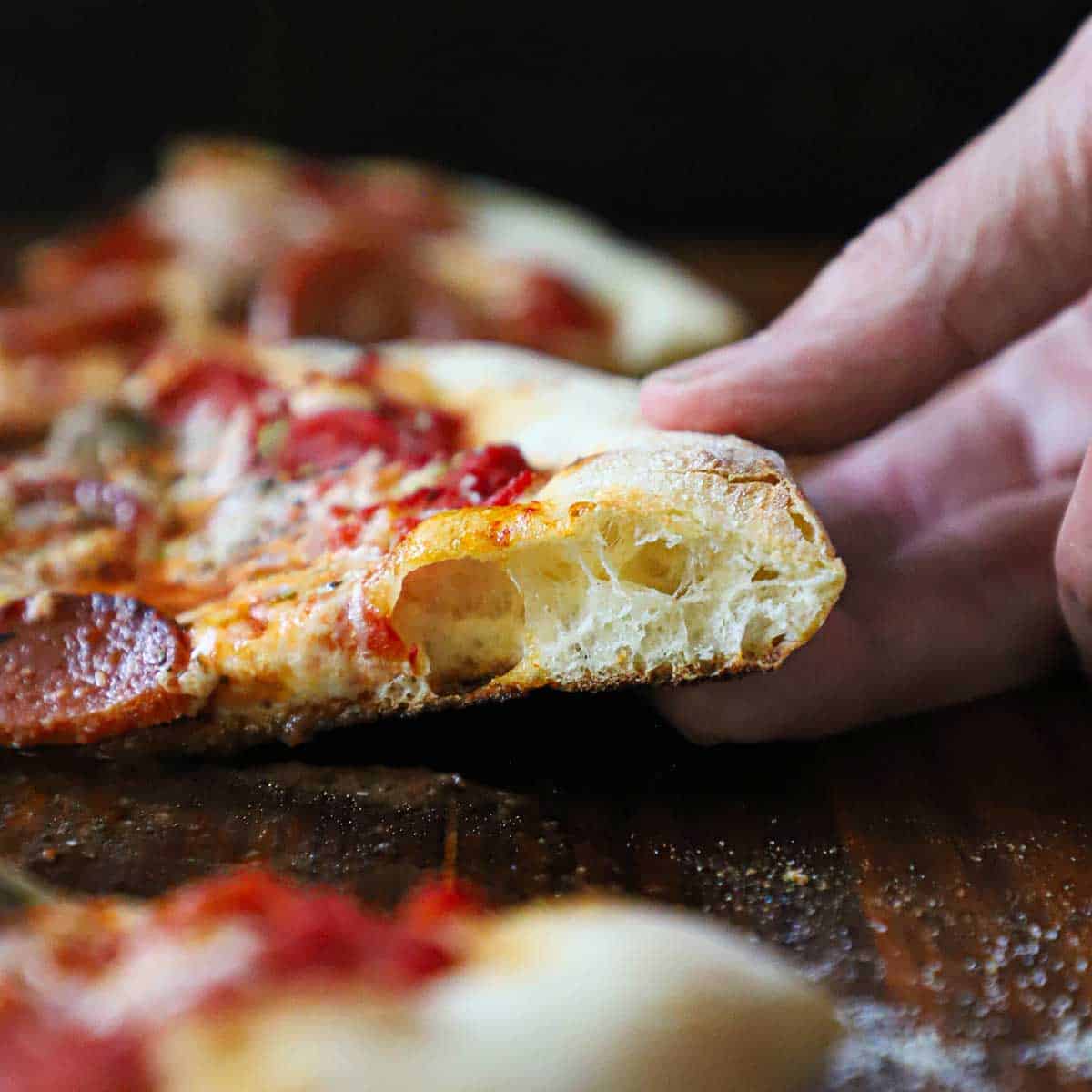
Thin and soft through the centre with an inflated, airy rim
Neapolitan-style dough is typically hand stretched rather than rolled, leaving gas in the outer edge so the cornicione can expand dramatically during a very fast, high-temperature bake.
- Hand stretched
- Soft centre
- Airy rim
- Very hot bake
- Little or no added fat
 Family 02
New York family
Thin, chewy and crisp enough underneath to support a large slice
New York-style pizza stays relatively thin but is usually more structured than Neapolitan pizza. The crust balances flexibility, chew and base crispness, giving the familiar foldable slice.
- Thin
- Foldable
- Chewy
- Crisp base
- Often contains oil
 Family 03
Roman and cracker-thin family
Very thin crusts where crispness matters more than a large airy rim
Roman tonda, Chicago tavern and generic cracker-style pizzas use different regional traditions, but all demonstrate how a dough can be shaped very thin and baked toward a dry, crisp or cracker-like result.
- Very thin
- Crisp
- Often rolled
- Small rim
- Firm structure
 Family 04
Detroit, Sicilian and pan family
Thick or moderately thick dough with an airy interior and crisp pan-baked base
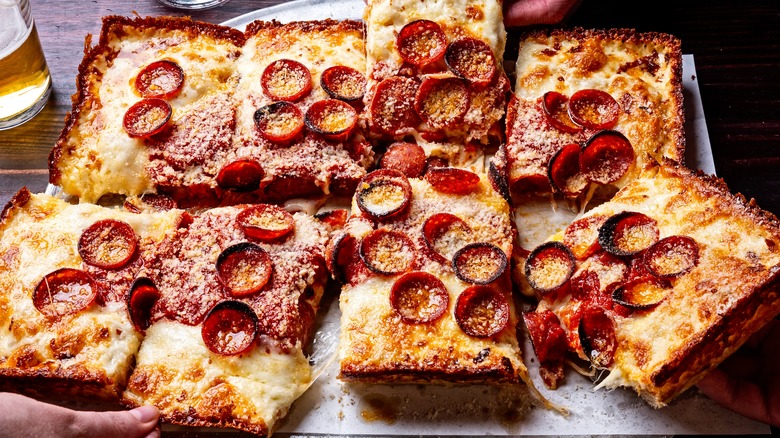
These pizzas use the pan as part of the baking system. The dough often proofs in the pan, while oil beneath and around it promotes a crisp exterior. Detroit, Sicilian, Grandma and other pan styles still differ considerably in thickness and formulation.
- Pan baked
- Airy crumb
- Crisp underside
- Higher dough weight
- Often higher hydration
A better way to compare crusts
Pizza styles sit on several different spectrums at once
There is no single line running from “thin pizza” to “thick pizza.” A style can be thin but soft, thin and cracker-crisp, thick and airy, or thick and rich. Thinking across several characteristics gives a much more useful description.
An important distinction
“Thick crust” is not one pizza style
Detroit, Sicilian, focaccia-style pizza, Grandma pizza and generic pan pizza can all use significantly more dough than a thin hand-stretched pizza. That does not make them interchangeable.
Detroit is known for an airy pan-baked structure and strongly crisped edges and underside. Sicilian is generally breadier and substantial. Grandma pizza tends to be thinner than classic Sicilian, while focaccia-style pizza pushes further toward an especially soft, aerated bread-like crumb.
Their differences become easier to understand once hydration, dough quantity, oil, fermentation and baking method are compared together rather than relying on thickness alone.
Stage 2 · Comparing the major pizza styles
Pizza styles differ in thickness, hydration, shaping and baking method — not just geography
A useful comparison looks beyond the name of the pizza and asks how the dough is actually handled. Some styles are stretched thin and baked directly on a hot surface, some are rolled until almost cracker-like, and others proof inside heavily oiled pans. Those structural choices explain much of the difference in the finished crust.
Neapolitan
Thin centre, inflated cornicione and a fast bake at very high heat.
New York
Foldable slices with a crisp underside and enough structure to carry toppings.
Roman Tonda / Tavern
Rolled or stretched thin with little emphasis on a large inflated rim.
Detroit / Sicilian
More dough, pan proofing and a thicker crumb with a crisp base.
Side-by-side reference
Twelve pizza styles compared by the characteristics of the crust
These descriptions are intended as practical reference points rather than rigid specifications. Individual bakers, pizzerias and regional traditions can use different formulations while still producing a recognisable version of the style.
| Style | Shape / format | Typical crust | Hydration tendency | Oil / fat | Shaping | Baking method | Typical result |
|---|---|---|---|---|---|---|---|
| Neapolitan | Round | Thin centre / puffy rim | Moderate to moderately high | Usually little or none in the dough | Hand stretched | Very hot oven / hearth or stone | Soft, tender centre with an airy blistered cornicione |
| New York | Large round | Thin / structured | Moderate | Often a small amount | Hand stretched | Hot deck, stone or steel | Chewy, foldable slice with a crisp underside |
| Roman Tonda | Round | Extremely thin | Lower to moderate | Can include a little oil | Stretched or rolled very thin | Hot oven / direct surface | Dry, crisp and delicate from centre to edge |
| Roman al Taglio | Rectangular tray | Thick / open | High to very high | Often some oil | Gently spread into tray | Tray baked | Light, open crumb with a crisp exterior |
| Detroit | Rectangular pan | Thick / airy | Moderately high to high | Oil in dough and/or pan | Pressed and proofed in pan | Oiled metal pan | Airy interior, crisp fried-style base and caramelised edges |
| Sicilian | Rectangular tray | Thick / bread-like | Moderate to high | Often some oil | Spread and proofed in tray | Tray baked | Soft substantial crumb with a crisp base |
| Grandma | Rectangular pan | Moderately thin pan crust | Moderate | Usually oil in pan and dough | Pressed into pan | Oiled sheet pan | Crisp underneath with less height than classic Sicilian |
| Chicago deep-dish | Deep round pan | Thick / rich | Lower | High fat content | Pressed up pan sides | Deep pan bake | Substantial, rich and pie-like rather than airy |
| Chicago tavern | Round, square cut | Very thin / cracker crisp | Lower | Often moderate oil | Usually rolled | Hot oven / direct surface | Flat, firm and notably crisp |
| Focaccia-style | Tray | Very thick / airy | High to very high | Generous oil | Spread and proofed in tray | Oiled tray | Soft open crumb with a crisp, oily exterior |
| Thin / cracker crust | Usually round | Flat / very thin | Lower | Varies | Frequently rolled | Direct hot surface | Dry, crunchy crust with minimal rim development |
| Generic pan pizza | Round or rectangular | Medium to thick | Moderate to high | Usually oil in the pan | Proofed in pan | Oiled pan | Fluffy interior with a crisp, browned underside |
How the families separate
Similar-looking pizzas can come from very different dough systems
The most useful comparisons are often between styles that appear superficially similar but behave differently during shaping and baking.
Both are thin, but they aim for different structure
Neapolitan pizza prioritises tenderness and rapid expansion around the rim. New York pizza generally needs more strength through the base so a large slice can remain foldable without becoming floppy.
- Neapolitan: softer centre and more inflated rim
- New York: firmer base and stronger chew
- New York dough often includes some oil
- Neapolitan usually relies on a much hotter, shorter bake
One name can describe two almost opposite crust structures
Roman tonda is characteristically thin and crisp, while Roman al taglio is a high-hydration tray pizza designed for a much more open, airy internal structure.
- Tonda: thin, dry and crisp
- Al taglio: thicker, wetter and highly aerated
- Tonda is shaped thin before baking
- Al taglio is handled gently in a tray
Both are thick pan pizzas, but the finish is not the same
Detroit pizza usually emphasises a lighter airy crumb, heavily crisped underside and distinctive edge caramelisation. Sicilian pizza tends toward a broader bread-like structure, although there is considerable variation.
- Both use a pan as part of the cooking system
- Detroit often pushes crispness and edge frying harder
- Sicilian can feel softer and more bread-like
- Dough depth and pan geometry influence the result
Deep-dish is not simply an extra-thick airy pizza
Chicago deep-dish uses a richer dough pressed into a deep pan and behaves more like a structural shell for a substantial filling. Detroit and Sicilian pizzas depend more on fermented dough volume and open crumb development.
- Deep-dish dough is richer and generally lower in hydration
- The dough is shaped up the sides of the pan
- The finished crust is substantial rather than focaccia-like
- Its thickness comes from construction as well as dough quantity
The key distinction
“Thin,” “thick,” “crispy” and “airy” describe dimensions of a crust — not complete pizza styles
It is tempting to sort pizza into a simple thin-crust versus thick-crust split, but that hides most of the useful information. A Roman tonda and a New York slice can both be thin while differing greatly in flexibility and crumb. Detroit and focaccia-style pizza can both be thick while differing in fat level, pan treatment and edge structure.
A more informative description combines several traits at once: thickness, internal openness, crispness, flexibility, shaping method and baking environment.
A visual way to think about the styles
Each pizza has its own balance of thickness, crispness and internal openness
These bars are qualitative rather than laboratory measurements. Their purpose is to show why two styles can share one characteristic while still feeling completely different to eat.
Neapolitan
Thin through the centre with strong rim expansion and relatively low crispness.
New York
Thin but more structurally firm, balancing chew with base crispness.
Roman Tonda
Very thin and strongly crisp, with little need for an open airy crumb.
Roman al Taglio
Considerably thicker than tonda, with high internal openness and a crisp shell.
Detroit
Thick, highly aerated and strongly crisp where the dough meets the oiled pan.
Chicago deep-dish
Thick and substantial, but not intended to mimic the open crumb of a highly hydrated pan dough.
Why recipes vary
Pizza style names describe traditions, not one immutable formula
A useful recipe can sit comfortably inside a recognised style without matching one exact hydration percentage, fermentation time or flour choice. Bakers adapt formulas around flour strength, ambient temperature, oven capability and the result they want.
For that reason, later sections of this guide use representative ranges rather than presenting a single number as the only correct specification for a style.
The more useful question is whether the formulation and process work together to create the expected crust: soft or crisp, thin or thick, tightly structured or highly aerated.
Pizza formulation tool
Build the dough around the pizza style you want
The Pizza Dough Calculator helps translate a pizza style into practical ingredient quantities. Use it to calculate dough for your chosen pizza size and batch, while controlling key formulation variables such as hydration, salt, yeast, oil and individual dough-ball weight.
It is especially useful when moving between styles. A thin New York-style pizza, a soft Neapolitan dough and a thicker Detroit-style pan pizza may use different hydration levels, dough quantities and enrichment even when they begin with the same basic ingredients.
- Dough-ball weight
- Hydration
- Salt
- Yeast
- Oil
- Batch scaling
Calculate a dough formula for the pizza size and style you want to make.
Stage 3 · The dough formulas behind pizza styles
Baker’s percentages reveal how pizza styles differ before the dough even reaches the oven
Once pizza styles are compared by their crust, the next step is to look inside the dough itself. Hydration, salt, oil, yeast and fermentation can all be expressed relative to flour weight, making very different formulations easier to compare on the same scale.
Baker’s percentages make recipes comparable at any batch size
A pizza recipe written only in grams tells you what to weigh for one batch. Baker’s percentages tell you how the dough is structured. That means a 500 g flour batch and a 5 kg flour batch can be compared directly if their percentages are the same.
Hydration describes water relative to flour — not how thick the pizza will be
Hydration is one of the most discussed pizza variables because it affects dough consistency, extensibility and the potential for an open internal crumb. But it does not directly tell you whether the pizza will be thin or thick.
Oil changes texture and becomes especially important in pan styles
Added oil can make dough more tender, assist browning and alter how the crust crisps. In Detroit, Sicilian, Grandma and focaccia-style pizzas, oil around the dough can also affect the way the base and edges fry against the pan.
Yeast percentage only makes sense alongside fermentation time and temperature
A dough fermented for a few hours may require a very different yeast quantity from one fermented for a day or more. The warmer the dough and the longer the fermentation, the more carefully yeast quantity needs to be controlled.
Salt is not merely seasoning
Salt contributes flavour, but it also changes dough handling and fermentation behaviour. Pizza formulas often sit within a fairly narrow salt range compared with hydration or oil, yet even small changes can affect the finished dough.
The formula and the process must be designed together
A 75% hydration dough is not inherently better than a 60% dough. The useful question is whether the flour strength, fermentation, shaping method, baking temperature and intended style can support that hydration level.
Representative dough ranges
Different pizza styles tend to occupy different formulation ranges
These figures are useful orientation points, not universal standards. Pizzerias and home bakers adapt formulas around flour strength, oven capability, climate, fermentation schedule and the exact texture they want to achieve.
| Style | Typical flour | Hydration | Salt | Oil / fat | Illustrative IDY* | Fermentation tendency | Formulation character |
|---|---|---|---|---|---|---|---|
| Neapolitan | Tipo 00 / suitable pizza flour | 60–65% | About 2.5–3% | Usually 0% | About 0.05–0.2% | Medium to long | Lean dough designed for extensibility and rapid high-heat baking |
| New York | Strong / bread flour | 60–65% | About 2–3% | Often 1–3% | About 0.1–0.5% | Often long cold fermentation | Balanced strength, chew and crispness |
| Roman Tonda | 00 or strong flour | 55–60% | About 2–3% | Often 0–2% | About 0.1–0.5% | Medium to long | Firm enough to shape extremely thin and bake crisp |
| Roman al Taglio | Strong 00 / bread flour | 70–85% | About 2–3% | Often 1–3% | About 0.1–0.5% | Often long | High hydration aimed at an open, light tray-baked crumb |
| Detroit | Bread / strong flour | 68–75% | About 2–3% | Often 2–4% plus pan oil | About 0.3–1% | Medium to long | Wet, extensible dough built for pan proofing and strong oven spring |
| Sicilian | Bread / strong flour | 65–75% | About 2–3% | Often 2–5% plus pan oil | About 0.3–1% | Medium | Thicker, softer and more bread-like than thin stretched pizza |
| Grandma | Bread or all-purpose flour | 60–70% | About 2–3% | Often 2–5% plus pan oil | About 0.3–1% | Short to medium | Moderately hydrated pan dough intended to stay thinner than Sicilian |
| Chicago deep-dish | All-purpose / bread flour | 45–55% | About 1.5–2.5% | Often 10–20% fat | About 0.5–1% | Short to medium | Rich, structured dough rather than a highly aerated pizza bread |
| Chicago tavern | All-purpose flour | 45–55% | About 1.5–2.5% | Often 5–10% | 0–0.5% | Short to long depending on method | Firm dough designed for rolling and cracker-like crispness |
| Focaccia-style | Strong / bread flour | 70–85% | About 2–3% | Often 3–8% plus generous pan oil | About 0.3–1% | Medium to long | Very wet, oily dough designed for a soft, open crumb |
*Yeast note: the figures above are only illustrative instant dry yeast percentages. Yeast quantity should be calculated around the actual fermentation time, dough temperature and environment, rather than copied independently from a style table.
Understanding hydration
Hydration changes dough behaviour progressively rather than creating fixed categories
These ranges are best understood as a continuum. Flour absorption, mixing, fermentation and handling technique can make two doughs at the same hydration behave quite differently.
Firm and controlled
Relatively stiff dough that can suit rolled, cracker-style or richer low-hydration formulations.
Classic pizza territory
A widely useful range for hand-stretched pizza, balancing handling, extensibility and structure.
Wet and airy
Increasingly sticky dough with greater potential for a light, open crumb, especially in pan and tray styles.
Highly hydrated
Very wet dough that generally needs suitable flour, gentle handling and a process designed around high hydration.
Illustrative 1 kg flour comparison
Starting with the same flour weight makes the differences easy to see
Suppose four doughs each start with 1,000 g of flour. The flour stays fixed at 100%, while water, oil and yeast change according to the intended style. These are educational example formulas rather than canonical recipes.
Neapolitan
- Flour
- 1,000 g
- Water
- 630 g
- Hydration
- 63%
- Salt
- 28 g
- Oil
- —
- IDY*
- ~1 g
New York
- Flour
- 1,000 g
- Water
- 630 g
- Hydration
- 63%
- Salt
- 25 g
- Oil
- 20 g
- IDY*
- ~2 g
Detroit
- Flour
- 1,000 g
- Water
- 720 g
- Hydration
- 72%
- Salt
- 25 g
- Oil
- 30 g
- IDY*
- ~3 g
Roman al Taglio
- Flour
- 1,000 g
- Water
- 800 g
- Hydration
- 80%
- Salt
- 25 g
- Oil
- 20 g
- IDY*
- ~2 g
Do not read the yeast figures as fixed recipes. They are deliberately illustrative. A serious formulation should set yeast quantity around the actual fermentation schedule, dough temperature and yeast type.
What the percentages do not tell you
The recipe numbers are only one layer of the finished pizza
Two formulas can look nearly identical on paper and still bake very differently when the dough weight, shaping method or oven changes.
Dough-ball weight
A larger dough ball spread over the same pizza diameter creates a thicker crust. This is why dough weight relative to pizza area is central to a useful thickness-factor calculation.
Fermentation schedule
The same hydration and ingredient ratios can behave differently after a short warm rise versus a long refrigerated fermentation.
Oven capability
Dough intended for a very short high-temperature bake may need a different formulation or baking strategy when adapted to a domestic oven with a much lower maximum temperature.
The formulation principle
A pizza style is not a hydration number
Hydration is important, but it becomes meaningful only when paired with the rest of the system. Flour strength, dough quantity, fermentation, oil, shaping and oven temperature all influence whether the dough becomes a soft Neapolitan crust, a foldable New York slice, a crisp Roman base or an airy Detroit-style pan pizza.
That is also why a useful pizza dough calculator should do more than multiply a single recipe. It should allow the baker to control hydration, salt, yeast, oil, dough-ball weight and the intended pizza style together.
Pizza formulation tool
Build the dough around the pizza style you want
The Pizza Dough Calculator helps translate a pizza style into practical ingredient quantities. Use it to calculate dough for your chosen pizza size and batch, while controlling key formulation variables such as hydration, salt, yeast, oil and individual dough-ball weight.
It is especially useful when moving between styles. A thin New York-style pizza, a soft Neapolitan dough and a thicker Detroit-style pan pizza may use different hydration levels, dough quantities and enrichment even when they begin with the same basic ingredients.
- Dough-ball weight
- Hydration
- Salt
- Yeast
- Oil
- Batch scaling
Calculate a dough formula for the pizza size and style you want to make.
Stage 4 · Detailed pizza style profiles
The identity of a pizza style emerges from how its dough is fermented, shaped and baked
Formulation explains what is in the dough. Style becomes visible when that dough is given a particular thickness, fermentation schedule, shaping method, baking surface and oven environment. Looking at those variables together makes the differences between Neapolitan, New York, Roman and pan pizzas much clearer.
From formula to finished crust
Similar ingredients can lead to completely different pizzas
Flour, water, salt and yeast appear across many pizza traditions. What changes is the system around them. A dough may be stretched by hand and baked directly on a very hot floor, rolled exceptionally thin for crispness, or proofed in an oiled pan so the base fries as the crumb rises.
The profiles below therefore focus on four things: dough character, shaping, baking environment and finished texture. The stated hydration and temperature ranges should be read as representative rather than mandatory specifications.
Major pizza families in detail
Seven profiles explain how the best-known crust systems differ
Some names describe tightly defined traditions, while others cover a broader family of regional and modern interpretations. The goal here is to understand the characteristic dough logic behind each one.
Neapolitan
Soft thin centre, inflated cornicione and a very short high-temperature bake
Neapolitan pizza is built around extensibility and rapid oven expansion. The centre is opened thin by hand while the outer edge is handled gently so accumulated fermentation gases remain in the rim. In the oven, that rim expands dramatically into the characteristic cornicione.
The dough is generally lean, without relying on significant added fat for tenderness. Much of the final texture comes from the combination of fermentation and an exceptionally fast bake.
New York
Thin and foldable, but stronger and crisper than a soft Neapolitan centre
New York pizza has to balance contradictory qualities. The slice should stay thin enough to fold, yet strong enough to support sauce, cheese and toppings. It is generally chewier and firmer underneath than Neapolitan pizza.
Strong flour, cold fermentation and a small addition of oil are common tools for creating that balance. The longer bake used in comparison with very-high-temperature Neapolitan pizza also encourages more extensive base crisping and browning.
Roman
One regional label can describe both exceptionally thin pizza and highly aerated tray pizza
Roman pizza is particularly useful for showing why a regional name does not always correspond to one crust structure. Roman tonda and pizza al taglio sit at very different points on the thickness and hydration spectrum.
Roman Tonda
A round pizza opened extremely thin, often with a relatively firm dough and little emphasis on a large puffy rim. The goal is a crisp, delicate crust from edge to edge.
Roman al Taglio
A rectangular tray pizza commonly associated with much higher hydration and a highly open internal structure. It is airy inside while remaining crisp externally.
Detroit
High-hydration pan pizza with an airy crumb and a strongly crisped exterior
Detroit-style pizza uses the pan as an active part of the crust design. The dough is relatively wet and is gently spread into a rectangular pan where it can proof before baking. Oil beneath the dough helps the bottom become notably crisp.
The characteristic edge is also part of the style. Cheese is commonly taken to the perimeter of the pan, where it can brown and caramelise against the metal while the interior dough remains light and aerated.
Sicilian & Grandma
Related pan traditions where dough depth and proofing produce noticeably different results
Sicilian-style pizza is generally associated with a substantial, bread-like tray crust. The dough proofs with meaningful depth, creating a soft interior while the pan and oil help brown the underside.
Grandma pizza also uses a rectangular oiled pan but is usually thinner and less bread-like. It occupies useful middle ground between a thin New York-style pizza and a taller Sicilian pan crust.
Sicilian
Higher dough quantity, deeper crumb and a softer, more bread-like internal structure.
Grandma
Shallower pan dough with a crisp underside and less overall height than a classic thick Sicilian-style crust.
Chicago
Deep-dish and tavern pizza show two almost opposite sides of the same city’s pizza identity
“Chicago-style pizza” is not one dough type. Deep-dish is thick, rich and constructed inside a deep pan, while tavern-style pizza is rolled exceptionally thin and baked toward a firm, cracker-like result.
Chicago deep-dish
Richer dough with comparatively low hydration and substantial fat, pressed across the base and up the sides of a deep pan.
Chicago tavern
Thin rolled dough with low hydration and a crisp, almost cracker-like bite, commonly cut into squares.
Focaccia-style & pan pizza
High hydration, generous oil and pan proofing move pizza toward a soft bread-like crumb
Focaccia-style pizza pushes the pan-pizza family toward high hydration, generous oil and substantial internal aeration. The dough is handled gently and allowed to expand in the tray rather than being stretched thin across a stone.
Generic pan pizza occupies a broader category and may be less hydrated or less oily, but the defining principle remains similar: the dough proofs in the vessel in which it will bake, giving the pan a direct role in thickness and crust formation.
Why pan pizzas deserve their own category
In pan pizza, the baking vessel becomes part of the formulation
A stone or steel mainly provides a hot contact surface. A pan affects the geometry of the dough, contains oil, limits spreading and creates a specific environment around the base and edges.
Dough depth
A pan fixes the available area, so the total dough weight largely determines thickness. More dough in the same pan creates a deeper crust.
Proofing in place
Detroit, Sicilian and focaccia-style doughs can complete part of their fermentation inside the pan, allowing gas cells to expand without the dough being stretched thin again.
Oil at the interface
Oil between dough and pan changes heat transfer and helps create the characteristic crisp, browned or almost fried underside associated with many pan styles.
Oven and baking method
Different crust systems need very different combinations of heat and time
Oven temperature cannot be separated from style. A dough designed for an extremely fast bake behaves differently from one intended to remain in a domestic oven long enough for a thick centre to cook through.
| Style | Representative oven range | Typical baking surface | Bake character | What the heat is trying to achieve |
|---|---|---|---|---|
| Neapolitan | Very high heat, often around 430–485°C in dedicated ovens | Hearth / stone floor | Extremely short | Rapid rim expansion and blistering before the centre dries |
| New York | High heat, often lower than Neapolitan | Deck, stone or steel | Longer than Neapolitan | Develop a crisp underside while retaining chew and flexibility |
| Roman Tonda | High | Direct hot surface | Thin, drying bake | Drive moisture from an exceptionally thin base for crispness |
| Roman al Taglio | Moderate to high | Tray | Long enough for thick open crumb | Set an airy interior while crisping the external surfaces |
| Detroit | Moderate to high, commonly compatible with domestic ovens | Heavy oiled pan | Pan bake | Cook through a thicker crumb while strongly browning base and edges |
| Sicilian / Grandma | Moderate to high | Rectangular pan | Pan bake | Set the interior without over-browning before the centre is baked |
| Chicago deep-dish | Moderate | Deep pan | Relatively long | Cook a substantial filled pizza through without relying on rapid oven spring |
| Chicago tavern | Moderate to high | Direct surface / pan depending method | Dry, crisp bake | Produce a rigid, cracker-like crust rather than a soft airy crumb |
Why style comparisons matter
The same hydration can belong to different pizzas because process changes what the dough becomes
Neapolitan and New York dough can occupy similar hydration ranges, yet one prioritises a soft centre and explosive rim expansion while the other aims for a stronger, chewier slice with more base crispness.
Likewise, Detroit and Sicilian can both be relatively wet pan doughs, but dough depth, oil, pan geometry and edge treatment produce recognisably different crusts.
The practical takeaway
Choose the crust you want first, then build the formula and process around it
Pizza formulation becomes easier when style is treated as a target texture rather than a label attached at the end. Decide whether the goal is soft and blistered, thin and chewy, cracker-crisp, or thick and airy. Hydration, dough weight, fermentation, shaping, oil and oven temperature can then be chosen to support that result.
Stage 5 · How formulation changes pizza texture
Hydration matters, but dough weight, fermentation, oil and oven heat determine what that hydration becomes
Pizza dough is a system of interacting variables. Changing one number rarely changes only one thing. More water can increase openness but also change handling. More oil can tenderise the crumb while increasing base crispness in a pan. A heavier dough ball can create a substantially thicker crust without changing the hydration at all.
Hydration changes dough consistency and the potential for an open crumb
Hydration measures water as a percentage of flour weight. Increasing it generally makes dough softer and more extensible, but it can also make the dough stickier and more demanding to handle. When flour, fermentation and shaping support it, higher hydration can contribute to a lighter, more open internal structure.
Dough-ball weight controls crust thickness more directly than hydration does
If two round pizzas are stretched to the same diameter, the one made from the heavier dough ball contains more dough per unit of area and will generally be thicker. The same principle applies to rectangular pan pizzas: more dough in the same pan produces greater depth.
Fermentation changes both flavour and the physical behaviour of the dough
Fermentation produces gas, develops flavour and changes the way the dough stretches. Time, temperature and yeast quantity all interact, which is why fermentation cannot be reduced to a simple rule such as “longer is always better.”
Oil changes tenderness, browning and the way pan crusts crisp
Oil inside the dough can soften the crumb and influence browning. Oil outside the dough — particularly between dough and pan — can affect heat transfer and create the strongly crisped underside associated with Detroit, Sicilian and other pan pizzas.
Flour strength sets practical limits on hydration and fermentation
Flour has to create enough structure to hold the gas generated during fermentation and survive shaping. A dough with very high hydration or a long fermentation schedule often benefits from flour suited to those demands.
Oven temperature determines how quickly the dough expands, sets and loses moisture
A very hot oven can expand and brown a thin pizza rapidly before much moisture escapes from the centre. A lower-temperature oven requires a longer bake, giving the crust more time to dry and making formulation choices such as oil and browning potential more important.
Thickness factor
Pizza thickness begins with dough quantity relative to surface area
Dough-ball weight becomes much more useful when it is related to pizza size. A 250 g dough ball can be relatively thick on a small pizza and relatively thin on a much larger one.
For a round pizza, area increases with the square of the radius. That means increasing diameter requires considerably more dough if the same crust thickness is to be preserved.
This matters when scaling a pizza from, for example, 10 inches to 14 inches. Simply adding a small amount of extra dough will not keep the same thickness because the larger pizza covers much more area.
Hydration and thickness factor solve different problems. Hydration tells you how wet the dough is. Thickness factor tells you how much dough is distributed across the baking area.
Useful for styles such as Roman tonda or other thin, crisp pizzas.
Enough dough to create a rim while maintaining a relatively thin centre.
Creates the depth needed for an airy internal crumb.
Changing one variable at a time
Each formulation change pushes the crust in a different direction
These are broad tendencies rather than guaranteed outcomes. Their value is in showing why pizza dough is easier to control when adjustments are made deliberately instead of changing several variables at once.
| Variable | If increased | Possible benefit | Possible trade-off | Especially relevant to |
|---|---|---|---|---|
| Hydration | Softer, wetter dough | More openness and extensibility potential | Stickier handling and greater dependence on flour / technique | Roman al taglio, Detroit, focaccia-style |
| Dough-ball weight | More dough over the same area | Greater crust thickness and internal volume | Longer bake and risk of undercooked centre if pushed too far | Pan pizza, Sicilian, Detroit |
| Oil in dough | Richer formulation | Tenderness and browning | Can move texture away from a lean, high-heat pizza profile | New York, Grandma, pan styles |
| Pan oil | More oil at dough / metal interface | Stronger base crisping and fried character | Heavier, richer exterior | Detroit, Sicilian, focaccia-style |
| Fermentation time | More time for dough development | Potentially greater flavour and extensibility | Requires lower yeast and control of dough strength / temperature | New York, Neapolitan, Roman styles |
| Oven temperature | Faster heat transfer | Quicker expansion and shorter bake | Can burn toppings or exterior if dough and style are not suited | Especially important to Neapolitan and thin styles |
| Flour strength | Greater structural potential | Can support longer fermentation or wetter dough | Excessively strong flour can produce unwanted toughness | High-hydration and long-fermented doughs |
Formulating for the oven you actually have
A dedicated pizza oven and a domestic oven reward different dough choices
Style should be adapted to the available heat rather than forcing an oven to imitate conditions it cannot produce.
Very fast baking favours doughs designed for rapid expansion
Neapolitan-style pizza is the clearest example. Extreme heat can inflate and char the rim while the centre remains soft because the pizza spends relatively little time drying in the oven.
This environment also changes how quickly sugars and fats brown, which is one reason very-high-temperature formulas are commonly kept lean.
Longer baking places more emphasis on browning and moisture management
New York, Detroit, Sicilian, Grandma and many pan pizzas adapt well to domestic ovens because their crust systems can benefit from the longer bake and strong contact heat from a steel or pan.
A domestic-oven version of another style may still be excellent, but it should be understood as an adaptation rather than an exact recreation of a bake performed hundreds of degrees hotter.
Controlled dough development
If you want to change your pizza, adjust the variable that actually controls the result
This is a better approach than increasing hydration simply because a crust feels too dense or adding yeast simply because a dough did not rise enough.
Reduce dough quantity for the same diameter or pan size
Thickness factor is the first variable to examine rather than hydration.
Review hydration, fermentation, flour and handling together
More water alone cannot compensate for weak structure or aggressive degassing.
Look at heat transfer, baking surface and oil
A hotter steel or oiled metal pan may matter more than changing yeast.
Consider flour choice, fermentation and final bake
Dough strength and moisture loss both contribute to the eating texture.
Reduce excessive drying and review enrichment
Bake duration, oil and dough thickness can all affect tenderness.
Control time, temperature and yeast as one system
Simply adding more yeast is not the only—or usually the most controlled—solution.
The dough design principle
Build backward from the crust you want
A useful pizza dough calculator should not begin with a generic recipe and simply multiply it. The better starting point is the intended pizza: its diameter or pan area, desired thickness, hydration, fermentation schedule, oil level and oven environment.
From there, dough-ball weight and baker’s percentages can be calculated to support the result. That makes the calculator a formulation tool, rather than merely a batch-size converter.